EU Registry Readiness
EU Registry Readiness is the operator-portal hub for preparing your company and your products for the EU Digital Product Passport Registry, the European Commission's central registry for digital product passports, separate from Traceable and described in full on the compliance page linked above.
This documentation is informational only and does not constitute legal advice. Consult qualified legal counsel for compliance decisions specific to your products and supply chain.
To open it, navigate to EU Registry Readiness in the Company Portal sidebar.
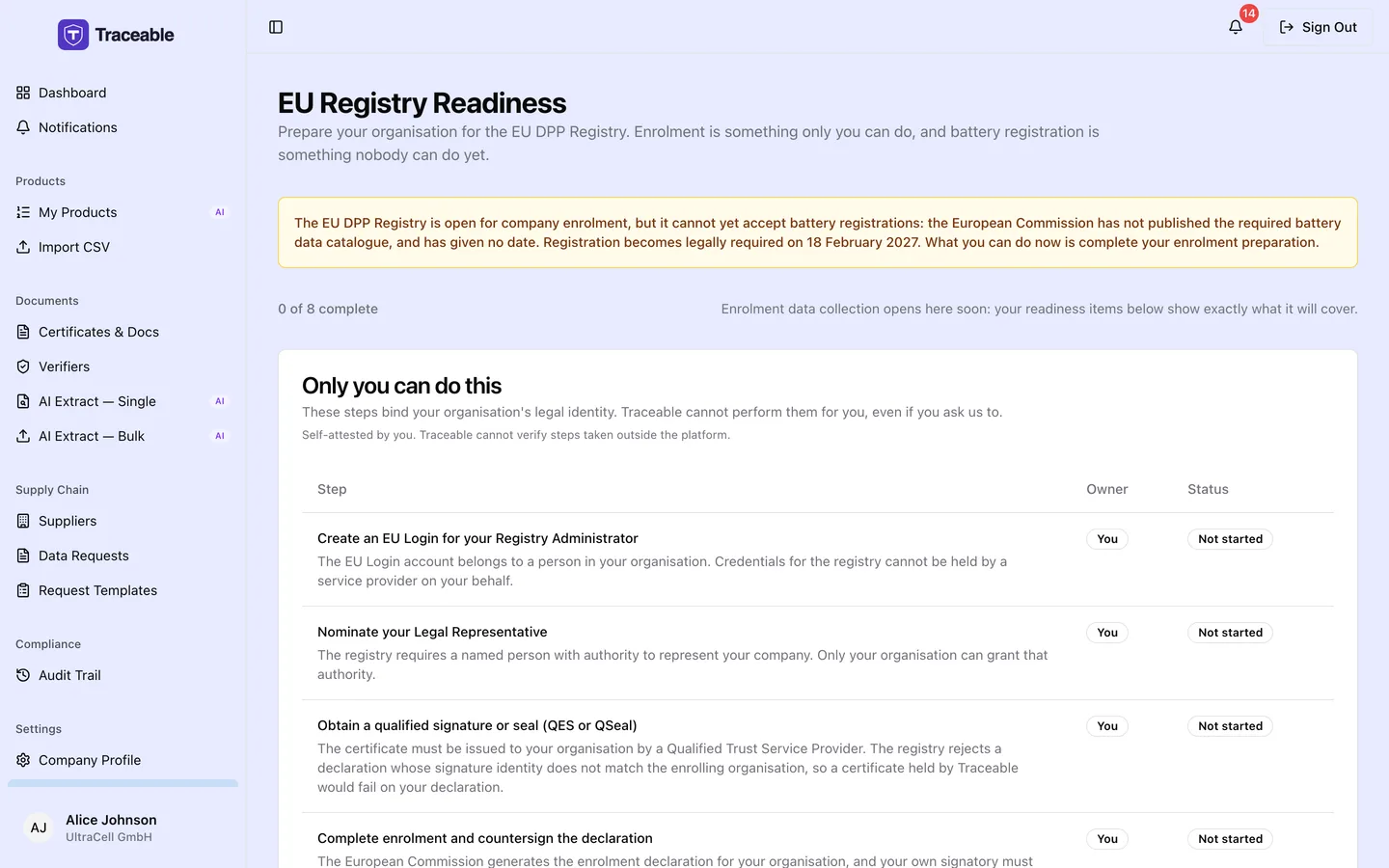
EU Registry Readiness.
Where things stand with the EU registry
The hub shows a status banner whenever battery registrations are not yet open, and its wording is the current state of play:
The EU DPP Registry is open for company enrolment, but it cannot yet accept battery registrations: the European Commission has not published the required battery data catalogue, and has given no date. Registration becomes legally required on 18 February 2027. What you can do now is complete your enrolment preparation.
In short: enrolment is something only your company can do, and registering an actual battery is something nobody can do yet, regardless of enrolment status. Everything below exists so that when the Commission opens battery filings, you are ready rather than starting from zero.
The readiness checklist
The hub tracks two kinds of readiness, each row labelled with who owns it (you or Traceable):
- Registry enrolment (self-attested): the steps your company completes directly with the European Commission, outside Traceable: an EU Login registry administrator, a nominated legal representative, a qualified electronic signature or seal, and the countersigned enrolment declaration. Only the Commission can verify your company's identity; Traceable tracks your progress, it cannot do these steps for you. The identity mechanics are described in Becoming a "Verified" User.
- Data readiness (computed): what Traceable can determine from your actual account data: enrolment data collection, the enrolment data pack, operator-type mapping, and product data readiness. For batteries, registration is item-level (each battery, not just each model), which is why product identifiers such as serial numbers matter here; see the 20-character identifier rule under GS1 prefixes.
Registration submissions
Below the checklist, the Registration submissions section is a working pipeline for preparing registry filings. It follows the registry's assisted-upload model: Traceable prepares the file, you submit it in your own EU registry session. Traceable never handles your EU Login credentials and never submits anything to the registry on its own.
The pipeline at a glance — note that the upload step happens in your EU registry session, never Traceable's:
The workflow, in order:
- Prepare a registration intent for a published product. This mints the product's item code and unique product identifier (UPI) and places it in the candidate pool. Only published (Approved) products qualify, and preparing intents requires the Editor role or higher on an active company account.
- Select candidates and generate the submission file. The file is downloaded to your machine, covering up to 100 items per file (a registry batch is all-or-nothing, so larger selections are split). Products already sitting in a pending submission are shown as excluded with an "In submission" badge, so the same item cannot ride in two files at once.
- Upload the file in the EU registry yourself, in your own signed-in session, then paste the confirmation (correlation) ID the registry shows you back into Traceable. The submission moves to processing.
- Record the outcome. When the registry returns its response CSV, paste it in to record the verdict per item. Successful items become registered, with the registry URI captured; failed items return to the candidate pool for correction and resubmission. The response file itself is retained as evidence.
- Cancel if needed. A submission that is still pending (file generated, not yet acknowledged by the registry) can be cancelled, releasing its items. A submission that has reached processing cannot be cancelled, because the file may already be with the registry.
Registering a single battery? Copy its UPI from the pipeline and paste it into the registry's own online form instead of generating a file.
Test vs production registrations
Every registration records which registry environment it targeted. While the Commission has not opened battery registrations, filings can only target the registry's test environment (ACC), and such rows are clearly badged "Test (ACC), not a production registration". A test filing is a rehearsal, not the legal act of registration; only a production-environment registration will count once the EU opens battery filings. The switch from test to production is a governed platform setting, not something that flips silently.
What This Hub Is Not
This hub does not submit anything to the EU registry, and it does not replace the identity-verification process the Commission itself runs. Enrolment happens between your company and the Commission; submission files are uploaded by you, in your session; and battery registrations cannot become legally effective until the Commission opens battery filings, for which it has given no date. Traceable keeps this page and the changelog updated as that changes.
Related
- EU Digital Product Passport Registry: the full legal and technical reference for the registry this hub prepares you for
- GS1 prefixes and identifier rules: the identifier constraints that item-level registration depends on
- EU Battery Regulation Overview: battery-specific obligations