Documents
The Documents section is the central repository for all compliance documentation associated with your account. Every certificate, test report, declaration of conformity, and audit report that supports your DPP claims can be stored here, versioned, and associated with specific products and DPP fields.
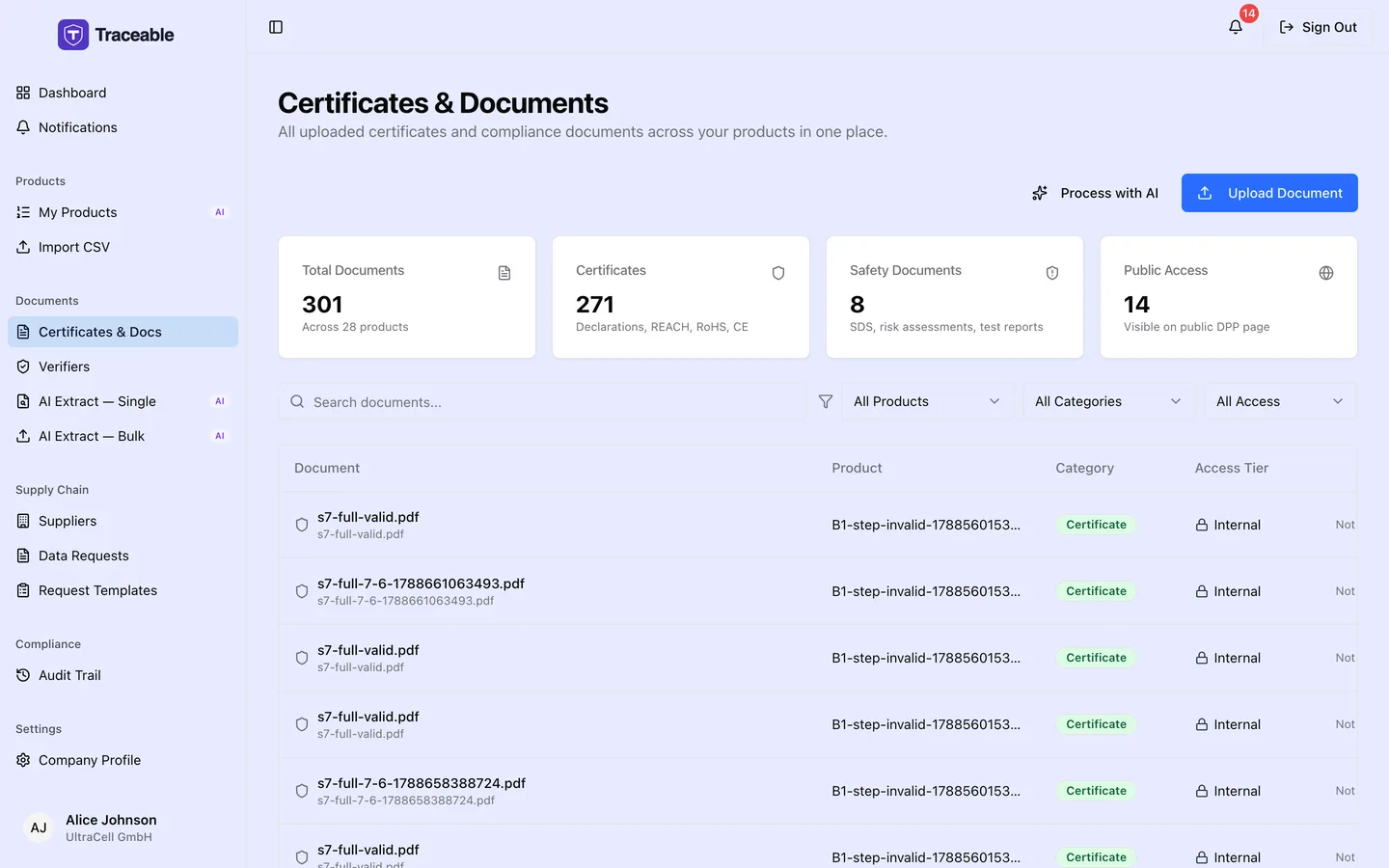
The document library.
Supported File Formats and Size Limits
Traceable accepts the following file types for document upload:
| Format | Extension | Best Used For |
|---|---|---|
.pdf | Declarations of conformity, test reports, certificates, audit reports | |
| JPEG | .jpg, .jpeg | Scanned documents, photographic evidence |
| PNG | .png | Screenshots, diagrams, scanned images |
| Word Document | .docx | Draft declarations, working documents |
Maximum file size: 25 MB per file.
For documents larger than 25 MB (common with multi-product test reports), consider splitting the document by test type or product range, or compressing the PDF before upload. PDF compression tools typically reduce file size significantly without quality loss for text-heavy documents.
Files are stored encrypted at rest. Traceable does not process or alter uploaded files in any way except as part of the Document AI extraction workflow (which requires explicit per-document consent).
Document Categories
When uploading a document, you must assign it to one of the following categories. The category determines how the document is classified in the document library, which filters it appears in, and which DPP sections it can be associated with.
| Category | Description |
|---|---|
| Test Report | Results of laboratory testing against an applicable standard (e.g., IEC 62133, UN 38.3, ECE R100). |
| Declaration of Conformity | A formal declaration by the responsible operator that the product meets the requirements of applicable EU legislation. |
| Certificate | A third-party issued certificate (e.g., CE certificate, UN 38.3 certification from an accredited laboratory). |
| Datasheet | Technical specification sheet, typically provided by the manufacturer, covering electrical and mechanical characteristics. |
| Audit Report | A report from an internal or external audit of manufacturing processes, environmental management, or supply chain practices. |
| Other | Any document that does not fit the above categories. A description field is required when selecting Other. |
Which Certificates Are Mandatory
For products in scope of the EU Battery Regulation, Traceable's publish gate checks that specific certificate types are present before a DPP can be published. Most of these are in force today for every applicable category. Two are date-gated: their underlying obligation exists in the Regulation but has not yet reached its compliance date, so the gate does not block publication on them yet.
| Certificate | In force today? | Applies to | Basis |
|---|---|---|---|
| UN 38.3 | Yes | All categories carrying lithium cells | UN Model Regulations transport testing |
| REACH Declaration | Yes | All categories | REACH Regulation (EC) 1907/2006 |
| CE Declaration of Conformity | Yes | All categories | EU Battery Regulation Art. 18, Art. 20 |
| CE Marking Declaration | Yes | All categories | EU Battery Regulation Art. 18, Art. 19 |
| IEC 62133-2 | Yes | Portable and light-transport lithium cells | Cell/battery safety standard |
| Carbon Footprint Verification | Not yet, for any category | EV, LMT, Industrial, Stationary | Art. 7; suspended pending the implementing act per the Commission's 28 July 2026 guidance (points 17-18). EV, Industrial and Stationary from 18 Feb 2028; LMT from 18 Aug 2028 |
| Due Diligence Report | Not yet, for any category | EV, LMT, Industrial (both >2 kWh and ≤2 kWh), Stationary | Art. 48, postponed to 18 August 2027 by Regulation (EU) 2025/1561; the postponement is turnover-scoped, so it applies to Industrial ≤2 kWh exactly as to the mandated categories. Art. 48's own scope also covers SLI (above the Art. 47 turnover threshold); the platform's certificate rule for SLI is governed by the voluntary keep-list |
The EV carbon-footprint row changed in September 2026: the Commission's guidance marks the carbon-footprint declaration "not to be filled/displayed as of February 2027, format still to be specified in the upcoming implementing act" for all categories including EV, superseding the earlier position under which EV Carbon Footprint Verification was in force from 18 February 2025 and blocked publication. The suspension is dated, not permanent: enforcement resumes automatically on each date above.
A certificate that is not yet mandatory is not hidden. It still appears in your document requirements with a "Mandatory from [date]" label, so you can see what's coming and prepare early rather than being surprised when the date arrives.
Voluntary-scope categories (SLI, Portable, Industrial ≤2 kWh) are additionally exempt from the Carbon Footprint Verification requirement altogether, because that requirement exists to serve the Art. 77 passport mandate these categories are outside of. Every other certificate requirement binds a voluntary category exactly as it binds a mandated one: UN 38.3, CE, REACH and the safety certifications exist independently of the passport mandate. See Voluntary battery passports.
Both the Carbon Footprint Verification and Due Diligence Report obligations exist in the Regulation now. What has not yet arrived is the date each one starts to bind. Traceable's gate reflects the Regulation's own timeline rather than either over-blocking (demanding evidence for an obligation that isn't due) or discounting the requirement (implying it no longer applies).
Uploading a Document
Single Upload
- Navigate to Compliance > Documents in the sidebar.
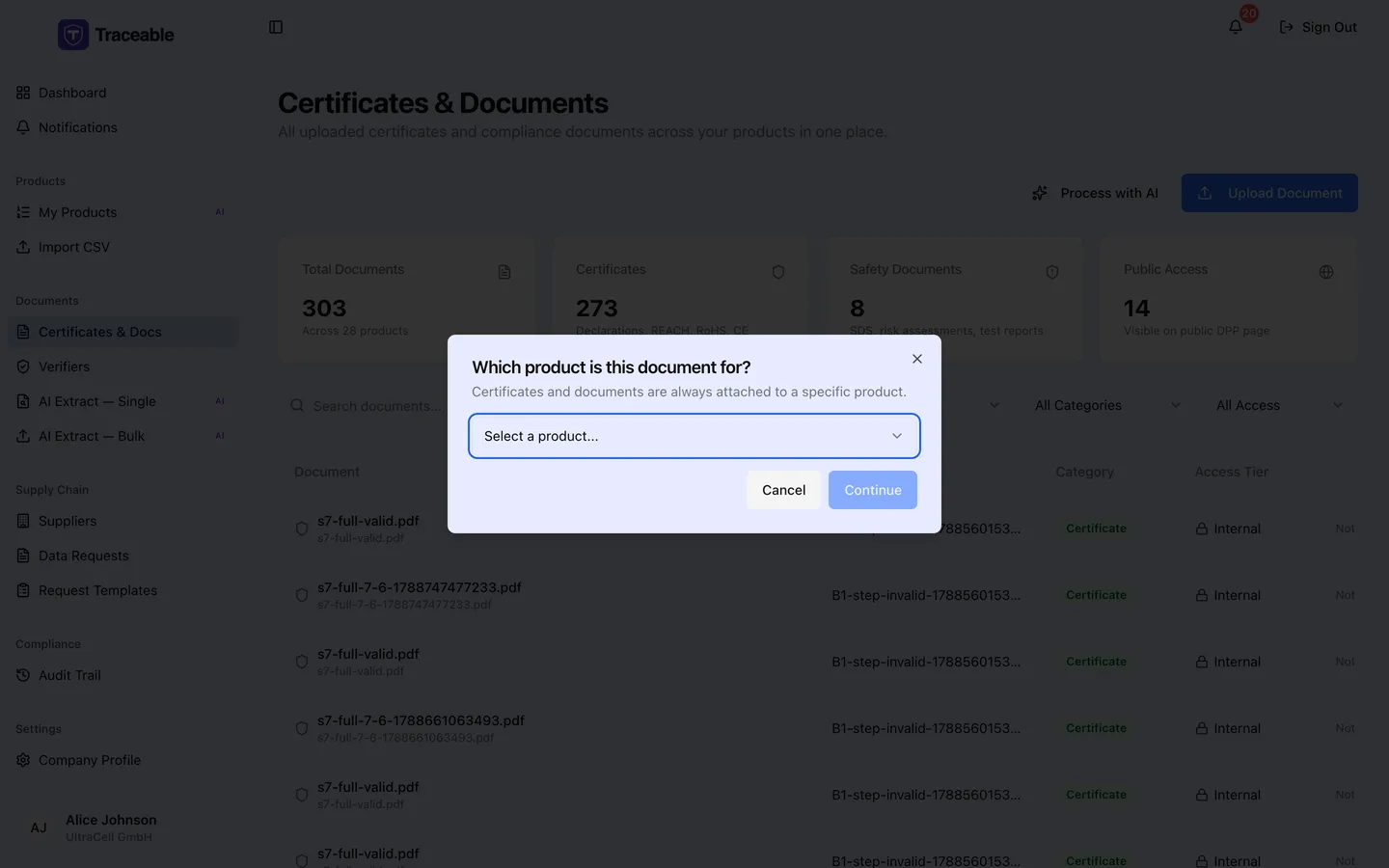
- Click Upload Document. The first thing it asks is "Which product is this document for?" — certificates and documents are always attached to a specific product, so pick one from the selector and click Continue before you get to the file itself.
- Choose the file, or drag it onto the upload area.
- Complete the document metadata form:
- Document name — a clear, descriptive name. If left blank, the filename is used.
- Category — select from the controlled vocabulary above.
- Document date — the date the document was issued or signed. Not the upload date.
- Expiry date — optional. Set this for documents with a validity period (e.g., certificates). Traceable will alert you when a document is approaching expiry.
- Issuing organisation — the body that issued the document (e.g., the test laboratory, certification body, or your own organisation for internally produced declarations).
- Reference number — optional. The document's own reference or report number, for cross-referencing with your internal systems.
- Click Upload. The upload is immediate for files under 10 MB. Larger files may take a few seconds.
Associating Documents with DPP Sections
A document uploaded to the library is not automatically linked to any product or DPP field. Association is a separate step that connects the document to the relevant part of a product's DPP.
From the Document Library
- Click on the document in the library.
- Start a new association.
- Select the product from the dropdown.
- Optionally, select which DPP section(s) this document supports (e.g., "Carbon Footprint", "State of Health", "Safety").
- Save the association.
From the DPP Editor
Within the DPP editor, each section has a Supporting Documents panel for attaching a document from your library to that section without leaving the editor.
A single document can be associated with multiple products and multiple sections. For example, a test report covering a family of battery models can be linked to all the relevant products simultaneously.
Document Access Controls
Each document has an access control setting that determines who can see it:
| Setting | Visibility |
|---|---|
| Internal only | Visible only to users on your Traceable account. Not visible to verifiers, not shown on the public DPP viewer. Use for working drafts, internal audit reports, and documents that support your compliance process but are not intended for external view. |
| Verifier access | Visible to verifiers who have been assigned a verification task for a product this document is associated with. Not shown on the public DPP viewer. Use for test reports and certificates that verifiers need to review. |
| DPP-visible | Visible on the public DPP viewer for any product this document is associated with. Use for Declarations of Conformity and certificates that the regulation requires to be publicly accessible. |
The default access control for a new upload is Internal only. You must explicitly change this to make a document available to verifiers or the public.
You can change a document's access control at any time from the document detail page. Changing from DPP-visible to Internal only will immediately remove the document from the public DPP viewer for all associated products.
Document Versioning
When a document needs to be updated (for example, a certificate is renewed with a new expiry date), do not delete the old document and upload a new one. Instead, use the versioning feature:
- Open the document in the library.
- Upload a new version.
- Upload the updated file and confirm the new document date and expiry (if applicable).
- Save the new version.
The new version becomes the active version. The previous version is retained in the version history and can be viewed or downloaded at any time. All existing product and DPP section associations are preserved and now point to the new active version.
The version history is visible in the document detail page under Version History. Each version shows the upload date, the user who uploaded it, and the document date.
This is important for the digital signature workflow: a digital signature is always applied to a specific version of a document. Uploading a new version does not carry forward any signatures; the new version must be signed separately.
Bulk Upload
To upload multiple documents at once:
- Go to Compliance > Documents.
- Click Bulk Upload.
- Drag multiple files onto the upload area, or select multiple files.
- For each file, complete the metadata form. Traceable presents the metadata form for each file in sequence. You can apply the same category and issuing organisation to every file at once from the top of the bulk upload dialog.
- Start the upload when all metadata is complete.
Bulk upload processes files sequentially. A progress indicator shows how many files have been uploaded successfully. If any file fails (for example, due to an unsupported format or size limit), the remaining files continue uploading and the failed file is flagged for retry.
Finding Documents
The document library includes a search bar and filter options:
- Search — full-text search across document name, reference number, and issuing organisation.
- Filter by category — show only documents of a specific type.
- Filter by product — show only documents associated with a specific product.
- Filter by access control — find all DPP-visible documents, or surface internal-only documents for review.
- Filter by expiry — identify documents expiring within a specified number of days. Use this to manage certificate renewals proactively.
Documents are sorted by upload date (newest first) by default. Click any column header to change the sort order.
The upload dialog
Upload Document opens a dialog where the file is chosen, named and classified before it is stored.