Create a product
This guide walks through creating a new product and building its Digital Product Passport from scratch. The DPP editor is a step-by-step wizard: the steps, the fields, and which of them are required all derive from the battery category you select.
To begin, navigate to Products in the sidebar and click New Product.
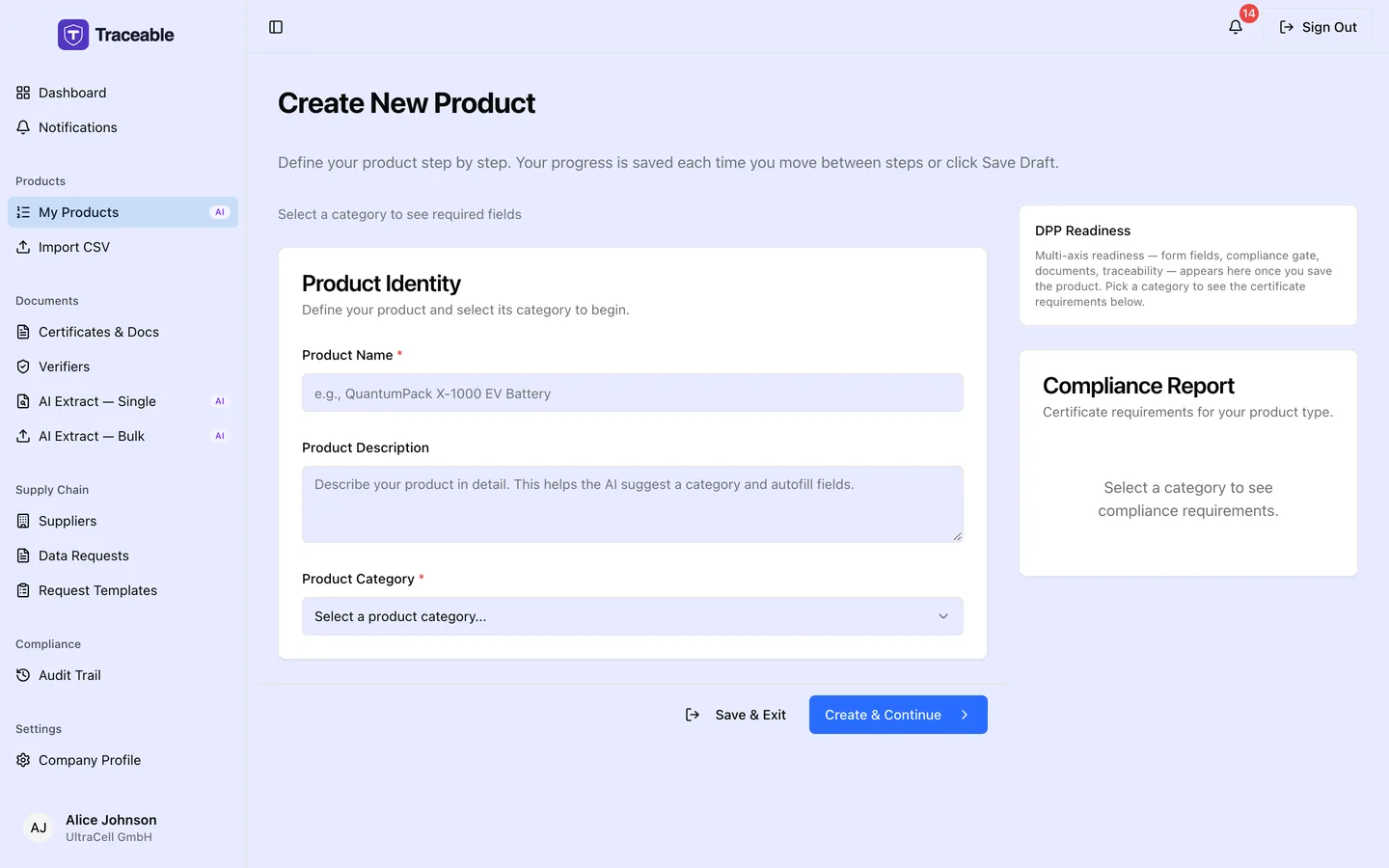
Starting a new product.
Step 1: Product Identity
The wizard always opens with Product Identity: the product's name and, most importantly, its battery category. The category is the most consequential choice in the flow because it determines the DPP schema (the full set of fields, which are mandatory, and the applicable regulatory thresholds).
The category dropdown lists DPP-mandated categories first, then voluntary-scope categories. Selecting a category outside the passport mandate shows an amber "DPP Not Required" notice explaining that a Digital Product Passport is not required for that category under EU Battery Regulation 2023/1542 Art. 77(1), and that you can still use Traceable for it voluntarily.
Once a category is selected, the step shows "What you'll need to fill" with the count of required fields for that category, so you know the size of the job before you start.
| Category | Code | Passport mandate | Notes |
|---|---|---|---|
| EV battery | BAT-EV-001 | Mandated (Art. 77(1), from 18 Feb 2027) | Traction batteries for road vehicles |
| LMT battery | BAT-LMT-001 | Mandated (Art. 77(1), from 18 Feb 2027) | E-bikes, e-scooters and similar light transport |
| Industrial battery (>2 kWh) | BAT-IND-001 | Mandated (Art. 77(1), from 18 Feb 2027) | Industrial machinery, forklifts, grid applications |
| Stationary battery energy storage | BAT-STAT-001 | Mandated (Art. 77(1), from 18 Feb 2027) | Regulated as industrial under Art. 3 |
| Industrial battery (≤2 kWh) | BAT-IND-002 | Voluntary | Outside Art. 77(1); see Voluntary battery passports |
| SLI battery | BAT-SLI-001 | Voluntary | Starting, lighting, ignition batteries |
| Portable battery | BAT-PORT-001 | Voluntary | Consumer and professional portable batteries |
You cannot change the category after a product is created. If you need to recategorise a product, create a new record and delete or archive the original.
The SLI and Portable templates are not yet offered on the production platform; their categories are currently selectable only on evaluation environments. Industrial ≤2 kWh (BAT-IND-002) is available everywhere and is the main voluntary-scope category in production use today.
How the wizard builds your steps
After Product Identity, the wizard adds one step per data section present in your category's template, and always ends with Review & Submit. The steps appear as numbered chips across the top of the editor; a chip turns green when its step is complete and red if it has validation errors, and you can click any chip to jump directly to that step.
The sections follow a canonical order. Which of them appear, and how many fields each carries, depends on the category (roughly 8 to 11 steps for the battery categories):
- Product Identification: the identifiers, including model, serial number, batch/lot, GTIN, passport URN, battery category, lifecycle status
- Manufacturer & Operator Details: the manufacturer, manufacturing place and dates, and the responsible economic operator
- Materials & Composition: chemistry, critical raw materials, recycled-content declarations, hazardous substances
- Carbon Footprint: the lifecycle carbon-footprint declaration and its verification references
- Sustainability & Circularity: durability, repairability and circularity data
- Performance & Durability: capacity, voltage, energy, cycle life, state-of-health parameters
- Safety, GPSR & Certificates: safety testing (UN 38.3 and related), GPSR contacts, certificates
- Regulatory Compliance: declarations, CE references, passport lineage links
- Supply Chain Due Diligence: raw-material sourcing and the due-diligence statement
- End of Life & Recycling: dismantling, collection and recycling information
Within a step, fields render in template order. Your work is saved when you click Next, Save & Exit, or Submit for Review; moving between steps saves the step you are leaving.
How a field tells you whether it blocks publication
| Indicator | What it means |
|---|---|
Red asterisk (*) | Required to publish today. A field whose obligation has not yet reached its compliance date does not carry one |
| Amber Not yet required chip | The field is an obligation for your category, but its compliance date is in the future, so it does not block today |
| Blue ESPR pill | The field is regulator-mandated. This appears on both blocking and not-yet-required fields, so it alone does not tell you whether the field blocks |
| Field tooltip | Names the specific date and article for the obligation, with a link to the Regulation text |
Each step reports its own requirement load. A step with outstanding required fields shows a banner counting them — "11 fields on this step still needed", with a Show control that lists them — and the review step summarises the whole passport the same way, as "7 of 84 required fields complete". Where the blocker is a regulator-mandated field, the gap list says so explicitly and offers a Fix link straight to the field.
Voluntary battery passports
For categories outside the Art. 77(1) mandate (SLI, Portable, and Industrial ≤2 kWh), the wizard applies a voluntary rule-set:
- Only a fixed safety and consumer-information keep-list of fields remains required: substance restrictions (REACH/CLP), CE declaration, the separate-collection symbol, UN 38.3 transport testing, GPSR contacts, end-of-life information, and the core identifiers. Everything that exists purely to serve the Art. 77 passport mandate stops being required.
- The required-field counter, the step progress, the validation, and the readiness sidebar all use the same relaxed rule-set, so a voluntary Industrial ≤2 kWh product shows on the order of two dozen required fields rather than the ~69 its mandated sibling carries.
- The Carbon Footprint Verification certificate requirement does not bind a voluntary category. Every other certificate requirement (UN 38.3, CE, REACH and the safety certifications) binds exactly as it does for mandated categories, because those obligations exist independently of the passport mandate.
- The published passport shows a "BattReg N/A (voluntary DPP)" chip in place of a regulation-conformance score, and a notice that the passport is published voluntarily. See the public view.
The legal line stays crisp: these categories have no passport obligation under Art. 77(1). A voluntary passport is a product capability, not a regulatory requirement, and nothing about publishing one creates an obligation you did not otherwise have.
Date-gated obligations: what blocks publication today
Several Annex XIII obligations exist in the Regulation but have not yet reached their compliance date. The wizard and the publish gate follow the Regulation's own timeline, informed by the European Commission's "Digital Batteries Passport — data points by category" guidance (28 July 2026, updated 15 August 2026):
| Obligation | Categories | Blocks today? | Starts to bind |
|---|---|---|---|
| Carbon footprint declaration and verification | EV, LMT, Industrial, Stationary | No | Industrial, Stationary and EV: 18 Feb 2028. LMT: 18 Aug 2028 |
| Supply chain due diligence statement | All mandated categories and Industrial ≤2 kWh | No | 18 Aug 2027 (Art. 48, postponed by Regulation (EU) 2025/1561) |
| Recycled-content declarations | EV, LMT, Industrial, Stationary | No | EV, Industrial, Stationary: 18 Aug 2028 (Art. 8(1) declaration date). LMT: Art. 8(1) second subparagraph sets 18 Aug 2033; Traceable's gate conservatively resumes on 18 Aug 2028 pending the Article 8 delegated act. SLI is in Art. 8 scope but outside the passport mandate; see the timeline |
Two points on the carbon footprint row, because it changed in September 2026: the Commission's guidance marks the carbon-footprint declaration "not to be filled/displayed as of February 2027, format still to be specified in the upcoming implementing act" for all categories including EV. Traceable therefore no longer blocks publication on EV carbon footprint either, superseding the earlier position under which EV blocked from 18 February 2025. This is a suspension pending the implementing act, not a removal: the enforcement dates are recorded in the platform and blocking resumes automatically on each date with no migration and no manual step. Data you do declare in these sections is still validated for internal consistency.
None of this means the obligations are optional. The fields stay visible, marked with the Not yet required chip and the date they start to bind. If Traceable cannot determine a product's battery category, it treats every mandatory field as blocking rather than assuming an obligation does not apply.
Lifecycle status and passport lineage
Every battery template carries a required Battery Lifecycle Status field (Annex XIII point 4) with five values:
Original, Repurposed, Re-used, Remanufactured, Waste
Two optional lineage fields accompany it in the Regulatory Compliance step: Original Passport URL (the passport of the battery this one was made from) and Linked Passport URN (the passport chain link). They become required at publish when the lifecycle status is Repurposed or Remanufactured, because a battery given a second life must point back at its original passport. A status of Re-used does not trigger the lineage requirement.
Related category-specific datapoints from the same guidance alignment:
- EV: a required State of Certified Energy (SOCE) field (0-100%). State of health and state of charge on EV are optional (the guidance marks them not-to-be-filled for EV).
- Industrial and Stationary: Expected Cycle Life and its related endurance datapoints are conditionally required, binding when the declared industrial application is stationary energy storage (home or commercial/grid) or forklift duty. They stay optional for UPS, telecom backup, and the "Other" application, which is deliberately not conditioned.
Commodity code (optional)
No operator role is required to provide a commodity code: the EU's DPP Registry helpdesk confirmed the code is not a required data element under the Battery Regulation, and Traceable does not enforce one.
If you declare one for your own customs or logistics purposes, the canonical format is the 8-digit EU Combined Nomenclature (CN) code under heading 8507 (electric accumulators), for example 8507 60 00. A 10-digit TARIC code is also accepted: the platform validates it by its 8-digit CN root (the last two TARIC digits encode import measures, not product identity) and your entered value is stored unchanged. This validation applies to products in scope of the DPP registry (EV, LMT, Industrial, Stationary).
Entering dates
Date fields open a calendar with month and year dropdowns, so reaching a manufacture date years back does not require paging month by month. You can also type the date directly in YYYY-MM-DD format, and a Clear button removes a value once one is set. Re-clicking the already-selected day closes the calendar without clearing your value.
The DPP Readiness sidebar
Alongside the wizard, the DPP Readiness panel shows what the platform actually knows about the product's path to publication:
- A Next step callout naming the single most useful next action, with the count of requirements remaining before submit
- Form Fields: filled versus required, with a progress bar
- Compliance Gate: "Passes", or the list of publish gaps, each with a Fix button that jumps you to the field or page that resolves it (gaps only an administrator can resolve are marked "Contact admin" instead)
- Documents: uploaded, required, verified, pending and expired counts
- Traceability: whether your category requires traceability rows and how many exist
The panel refreshes as you save, so the gate view you see in the editor is the same check that will run when you publish. Progress through steps is not sequential; you can work in any order and let the readiness panel tell you what is still missing.
After creating a product
A newly created product is saved as a Draft. From here you can:
- Continue filling the DPP steps
- Send data requests to suppliers for fields you do not hold directly
- Upload supporting documents in the Compliance section
- Return to the product list and come back later
When the DPP is complete and you are ready to make it publicly accessible, proceed to Publish a DPP.