The DPP editor, step by step
This page shows every step of the DPP editor as it actually appears, so you can see what you are being asked for before you start. The walkthrough below is an EV battery, which has 12 steps.
The steps are not a fixed list. They are derived from the field template for the product's battery category, so a portable battery or an industrial cell shows a different set. For how that derivation works, and why a field may be present but not blocking, see Create a product. For the authoritative, machine-readable field list per category, the API's category schema endpoint is the source of truth: see the Developer guide.
Two things apply on every step:
- Progress is saved per step. The editor saves the step you are leaving when you move between steps, and the header states this directly. There is no background auto-save while you type, so use Next, Previous or Save & Exit rather than closing the tab.
- The DPP Readiness panel is always on the right. It reports two separate things: how many form fields are filled, and how many compliance-gate gaps remain before the passport can be published. Those numbers are deliberately not the same — see Publish a DPP.
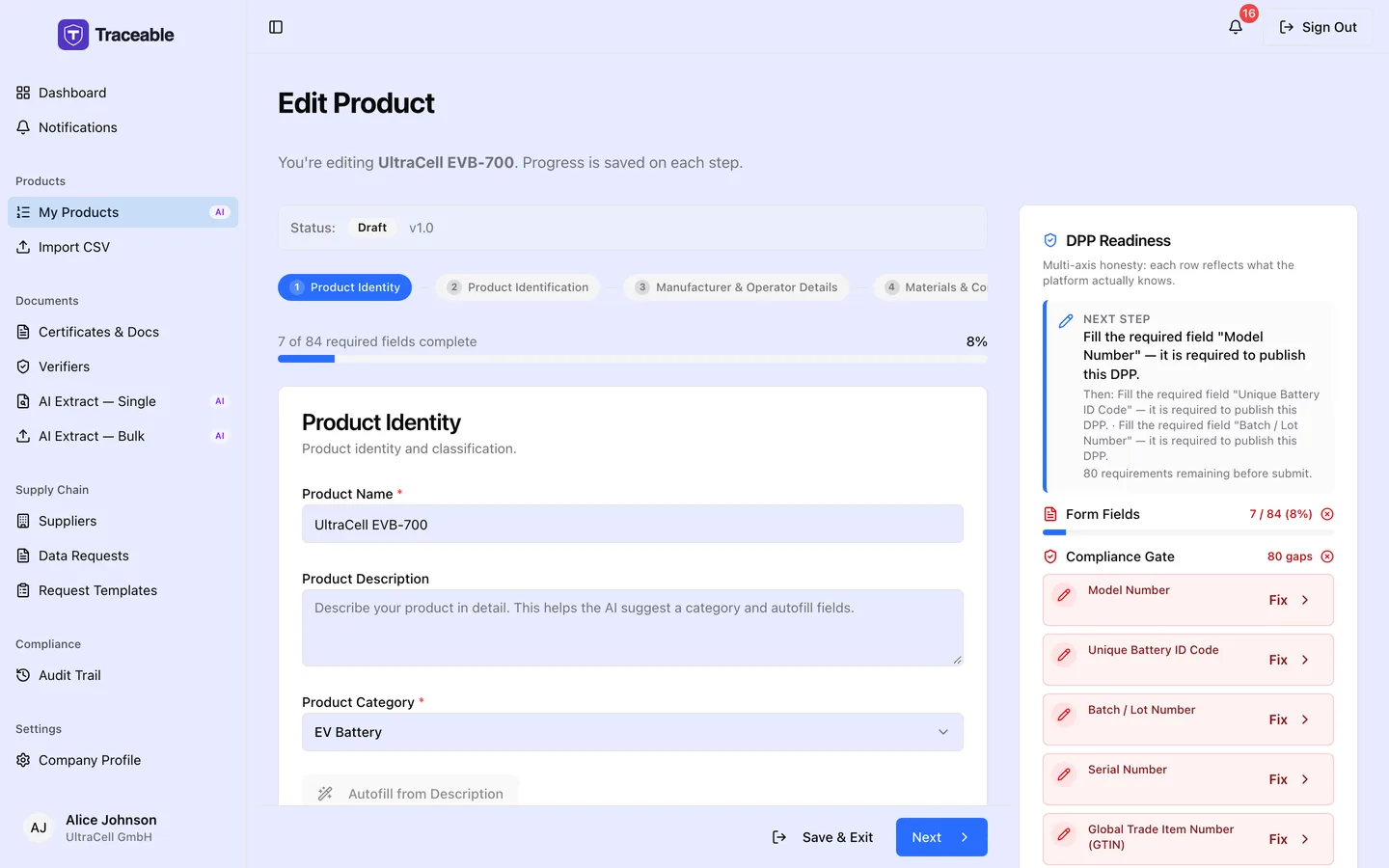
Step 1 — Product Identity
Where a product starts: its name, description and battery category. The category chosen here determines every step that follows.
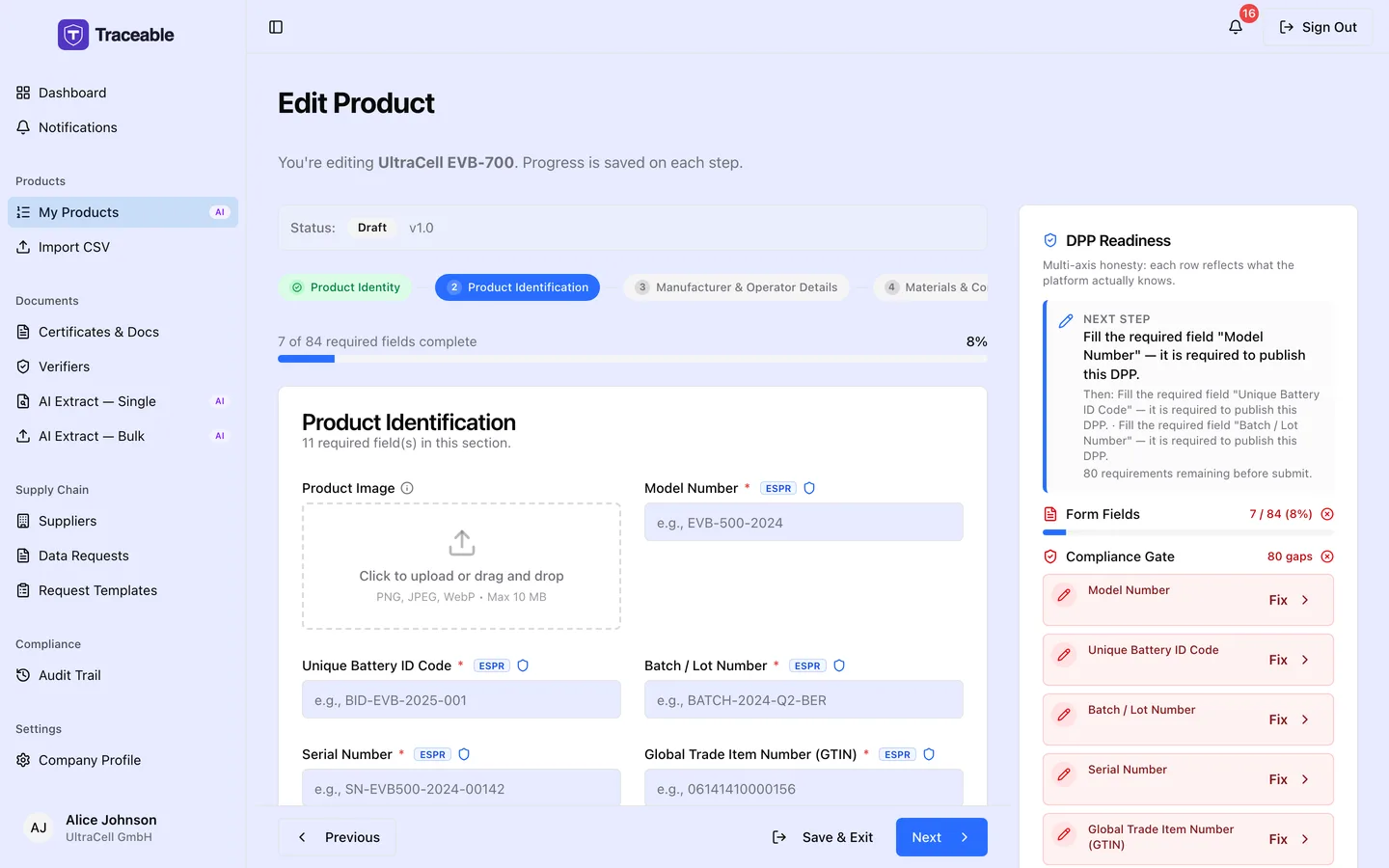
Step 2 — Product Identification
The identifiers that make the battery uniquely addressable, including the model number, batch or lot number, serial number and GTIN. These are the fields the public QR code and GS1 resolution depend on, so their formats are constrained: see GS1 prefixes.
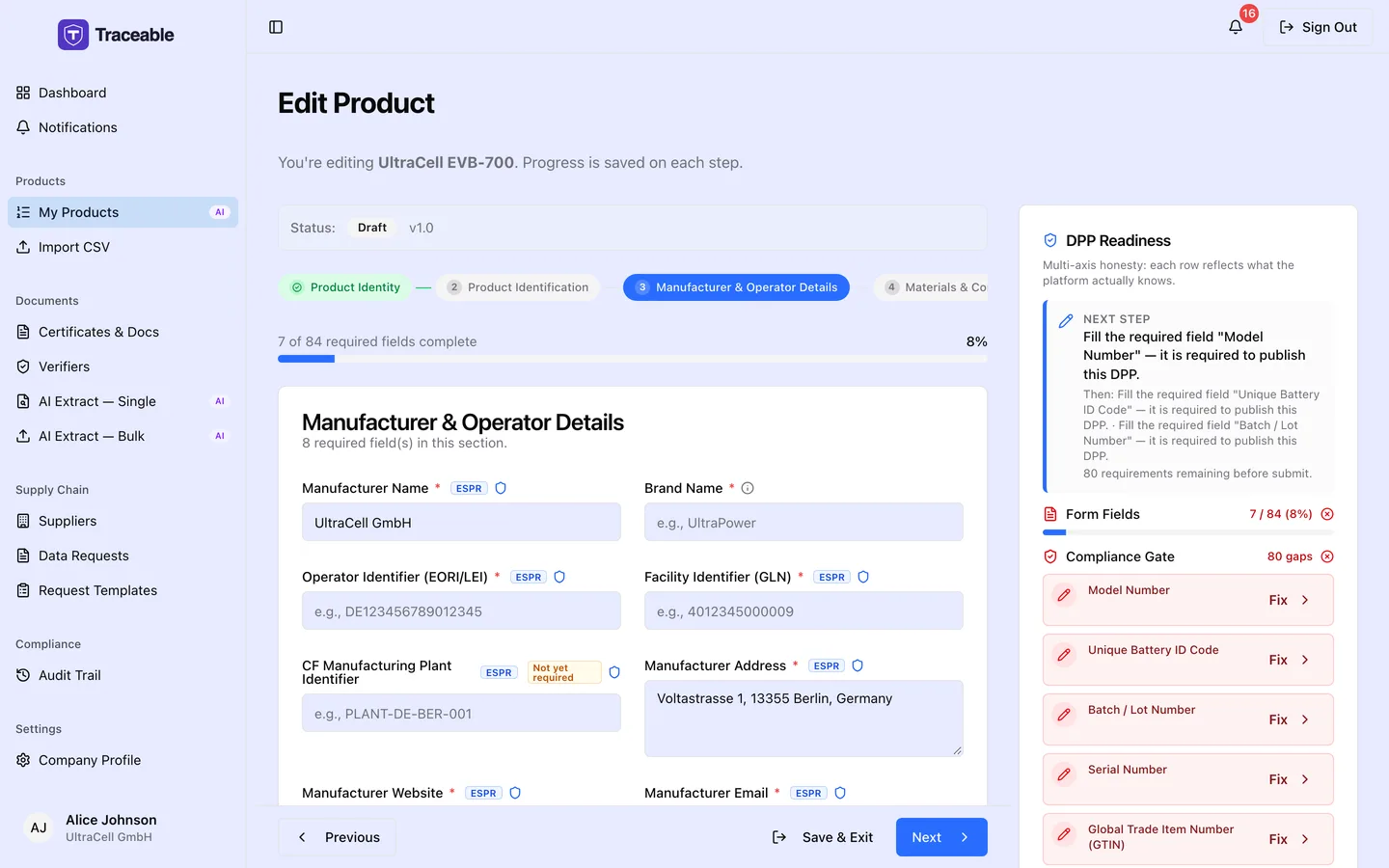
Step 3 — Manufacturer & Operator Details
Who placed the battery on the EU market, and in what role. This is where the economic-operator information required by the regulation is recorded.
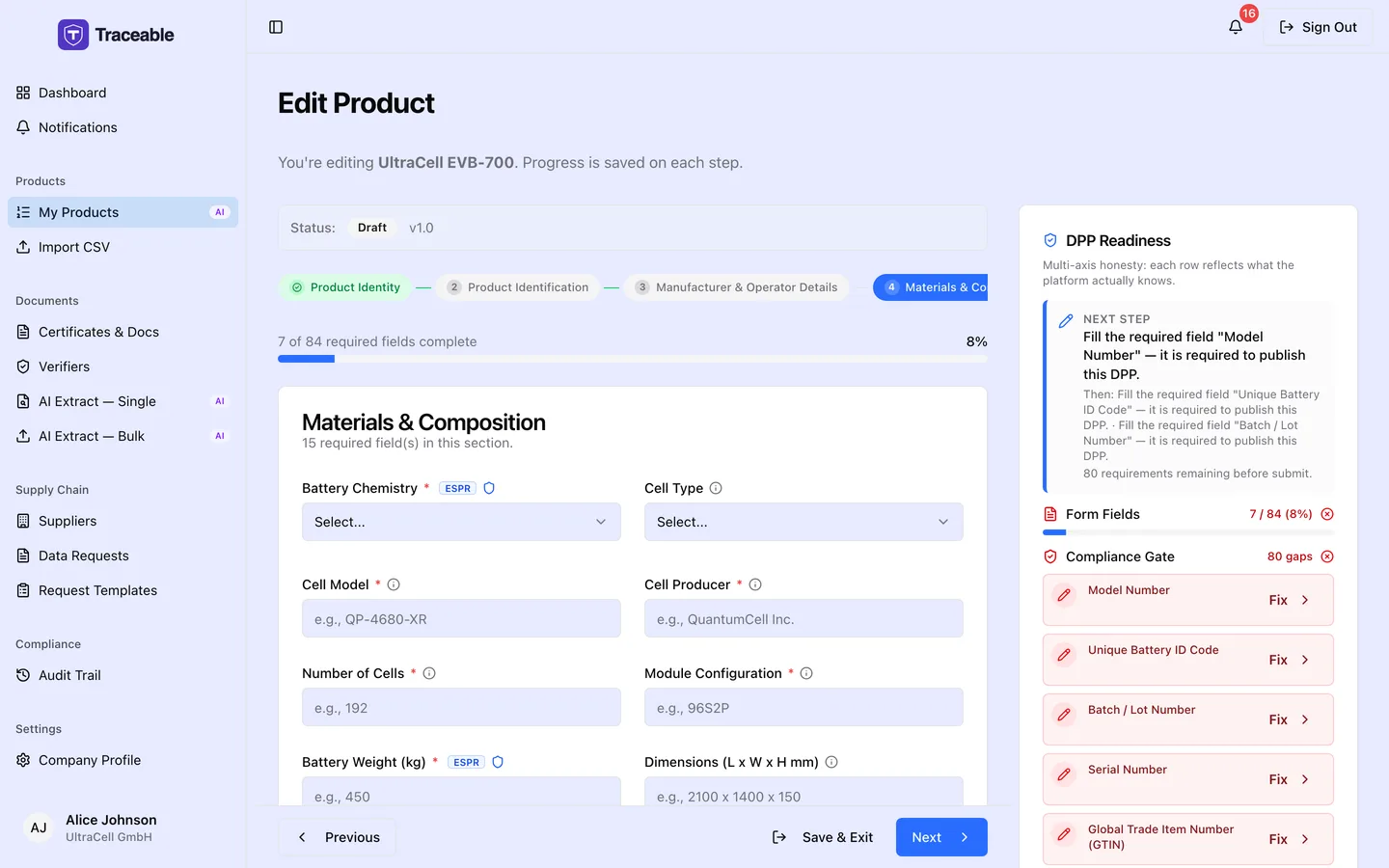
Step 4 — Materials & Composition
The battery's material make-up. This is the step that carries the composition data the recycled-content and substance-restriction obligations rely on.
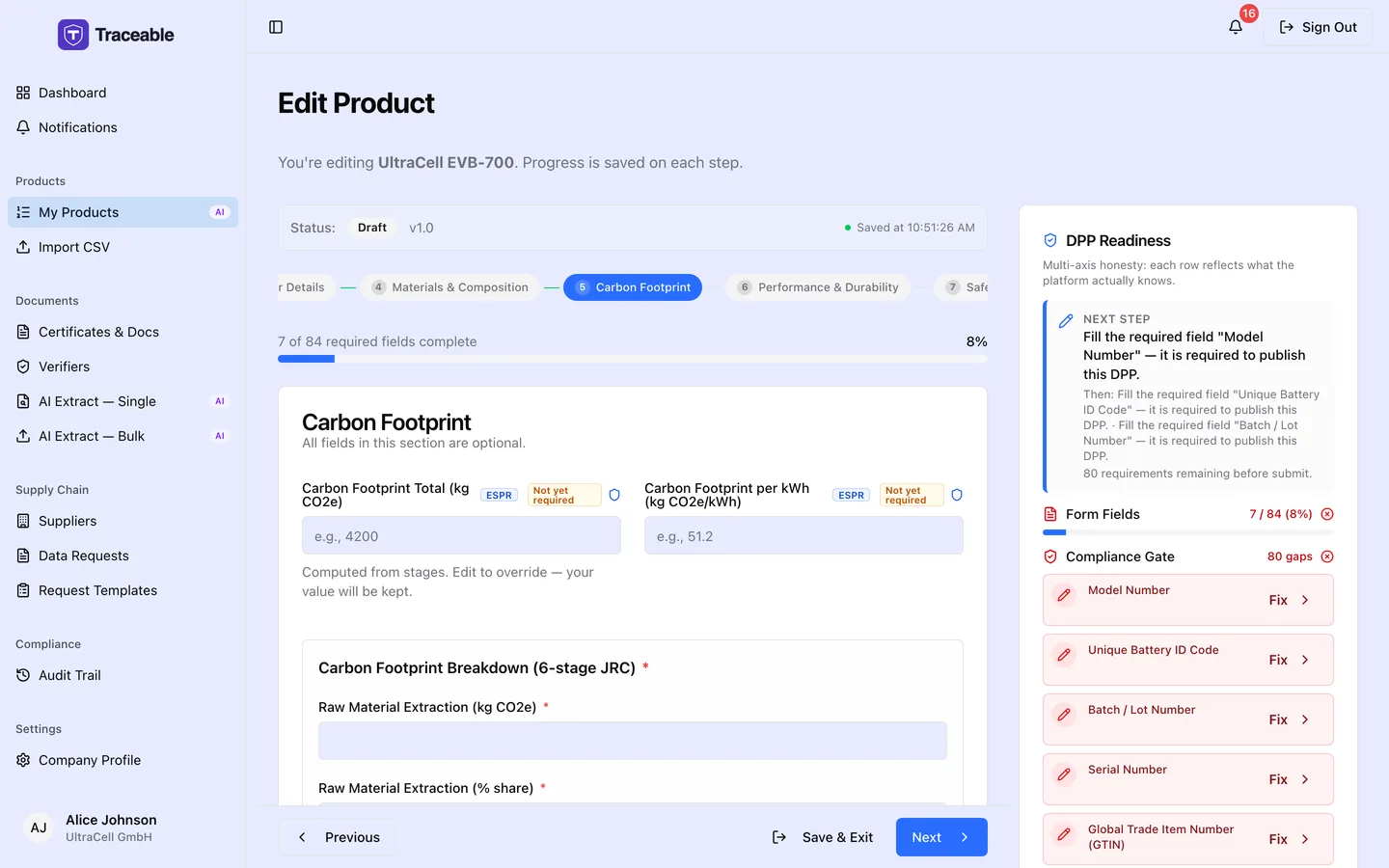
Step 5 — Carbon Footprint
The carbon-footprint declaration fields. Note that these do not currently block publication for any category: the Commission's guidance marks them as not to be filled or displayed pending the implementing act that will specify the format. See the enforcement timeline.
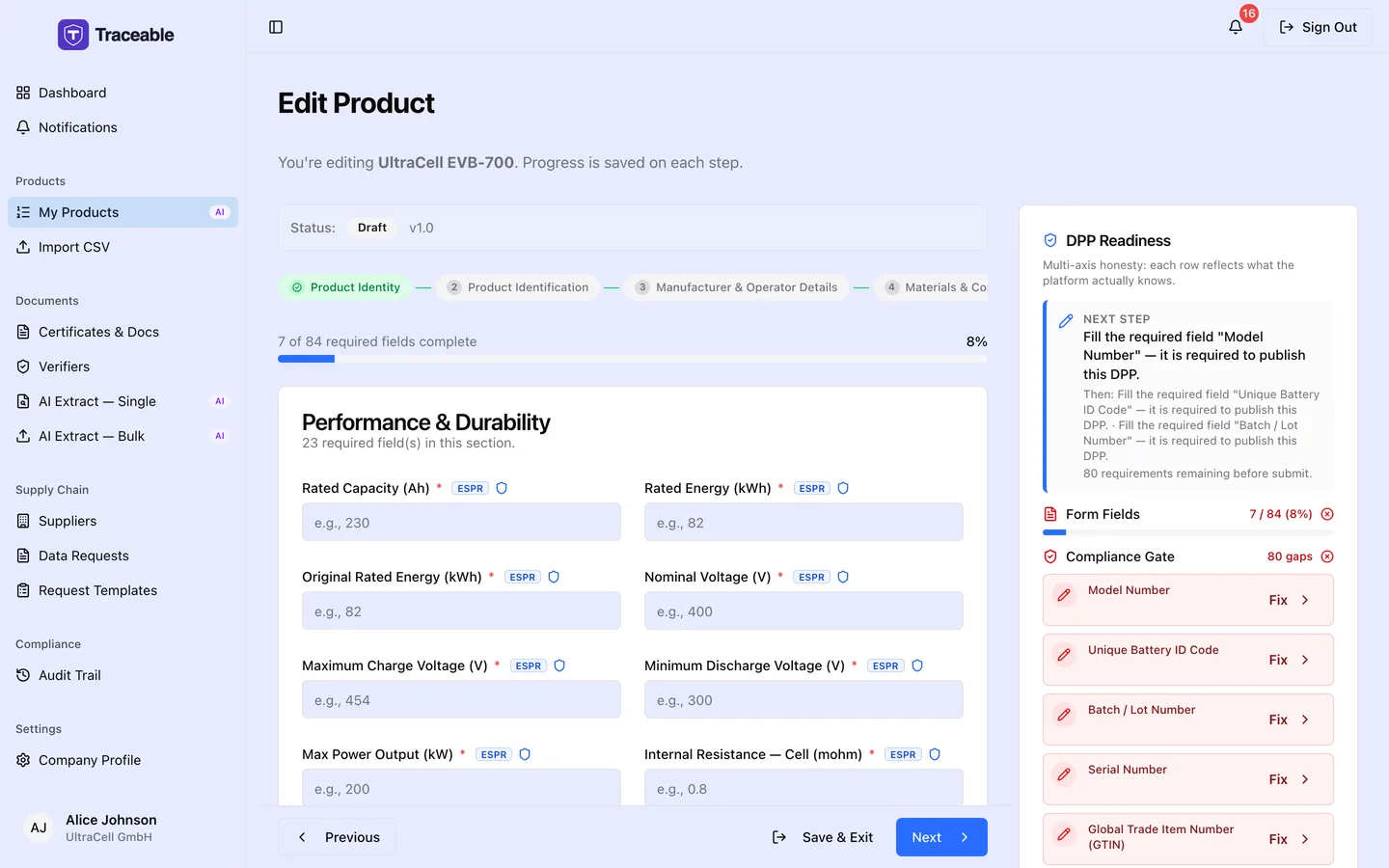
Step 6 — Performance & Durability
The electrochemical performance and durability parameters for the battery.
Step 7 — Safety, GPSR & Certificates
Safety information and the certificate requirements attached to this category. Certificates uploaded in Documents are matched against these requirements.
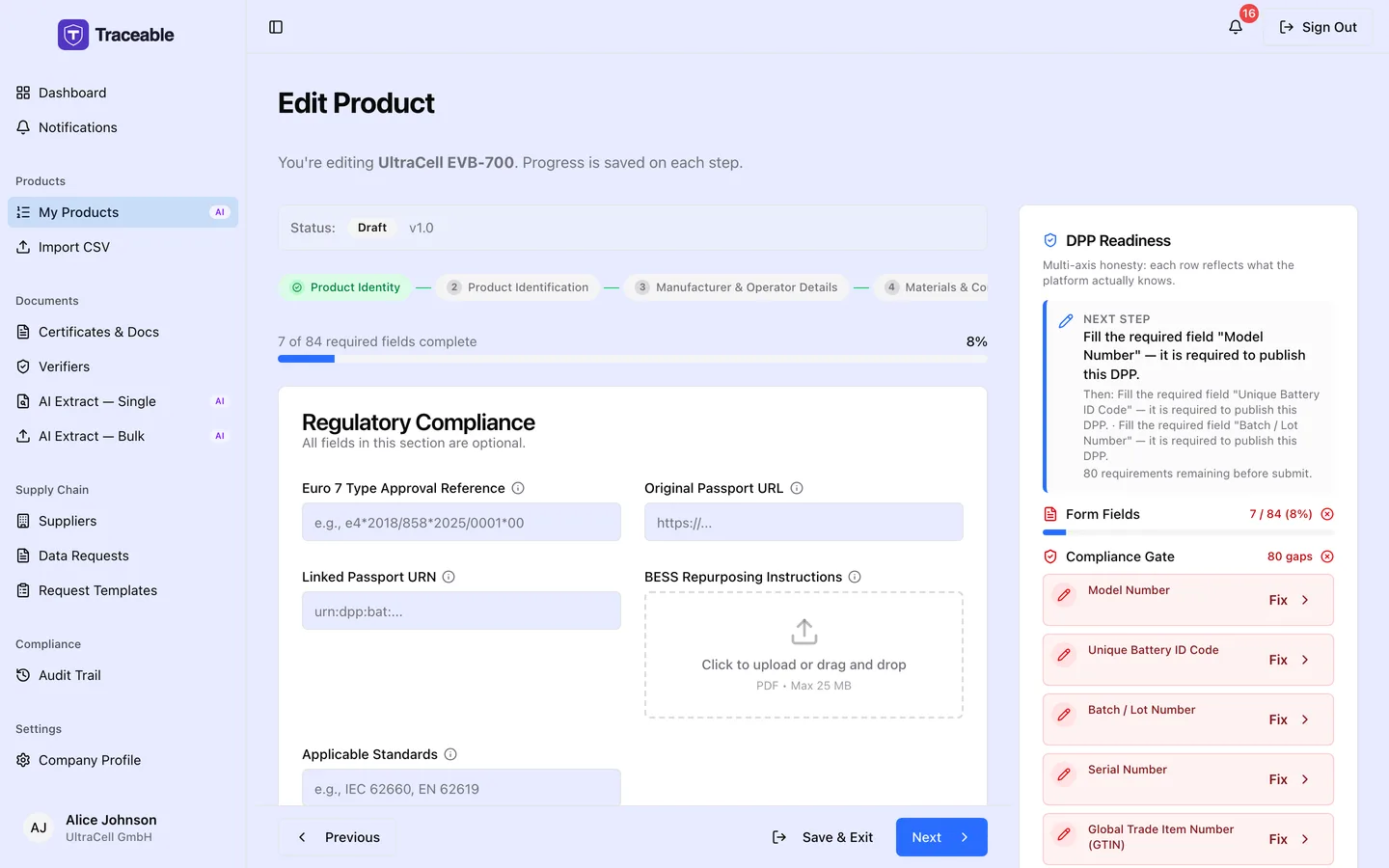
Step 8 — Regulatory Compliance
The declarations of conformity and regulatory markings that apply to the battery.
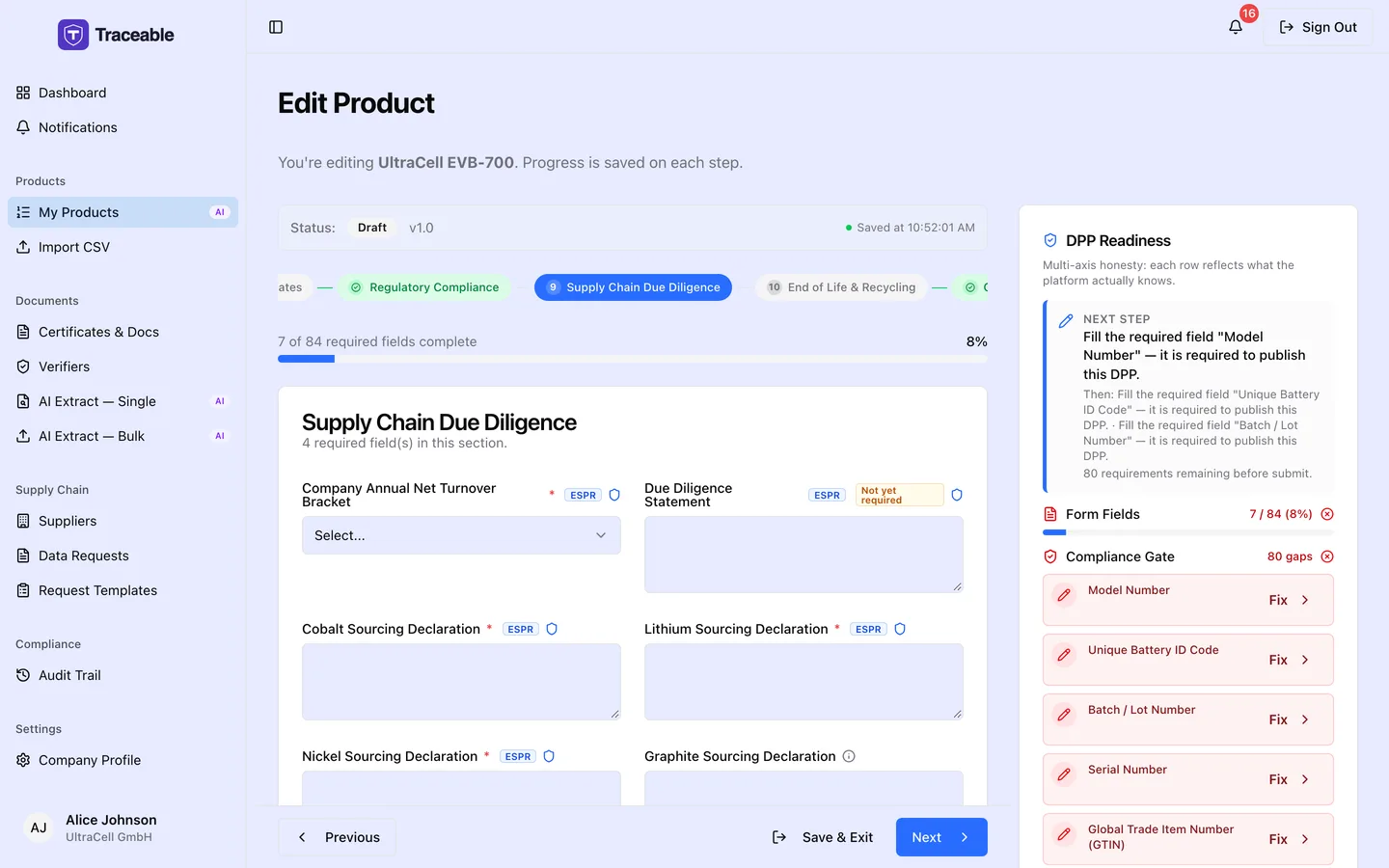
Step 9 — Supply Chain Due Diligence
The due-diligence information covering raw-material sourcing. This is the step most likely to need data you do not hold yourself — request it from suppliers rather than guessing: see Send data requests.
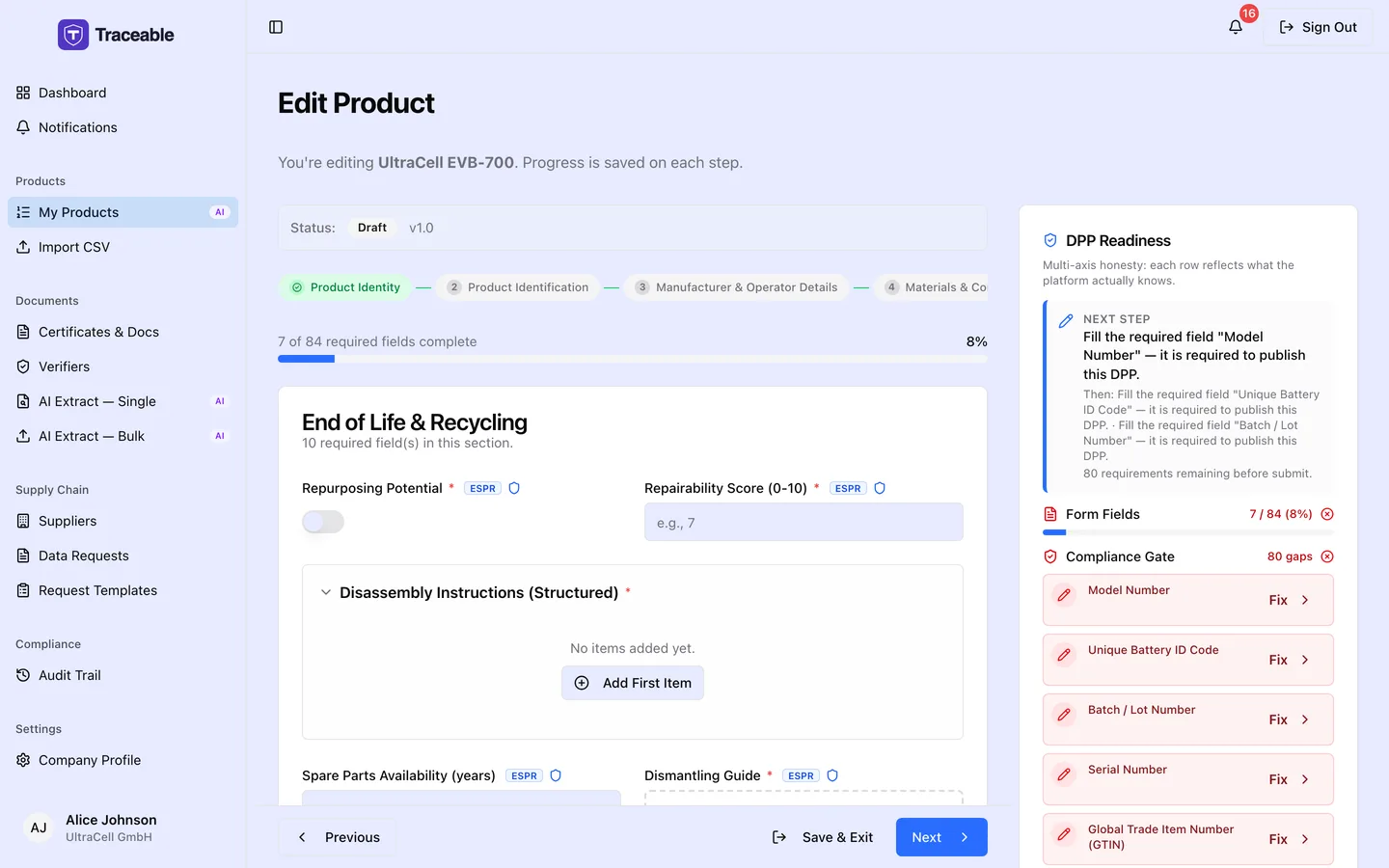
Step 10 — End of Life & Recycling
Collection, treatment and recycling information, including the separate-collection obligations that apply regardless of the passport mandate.
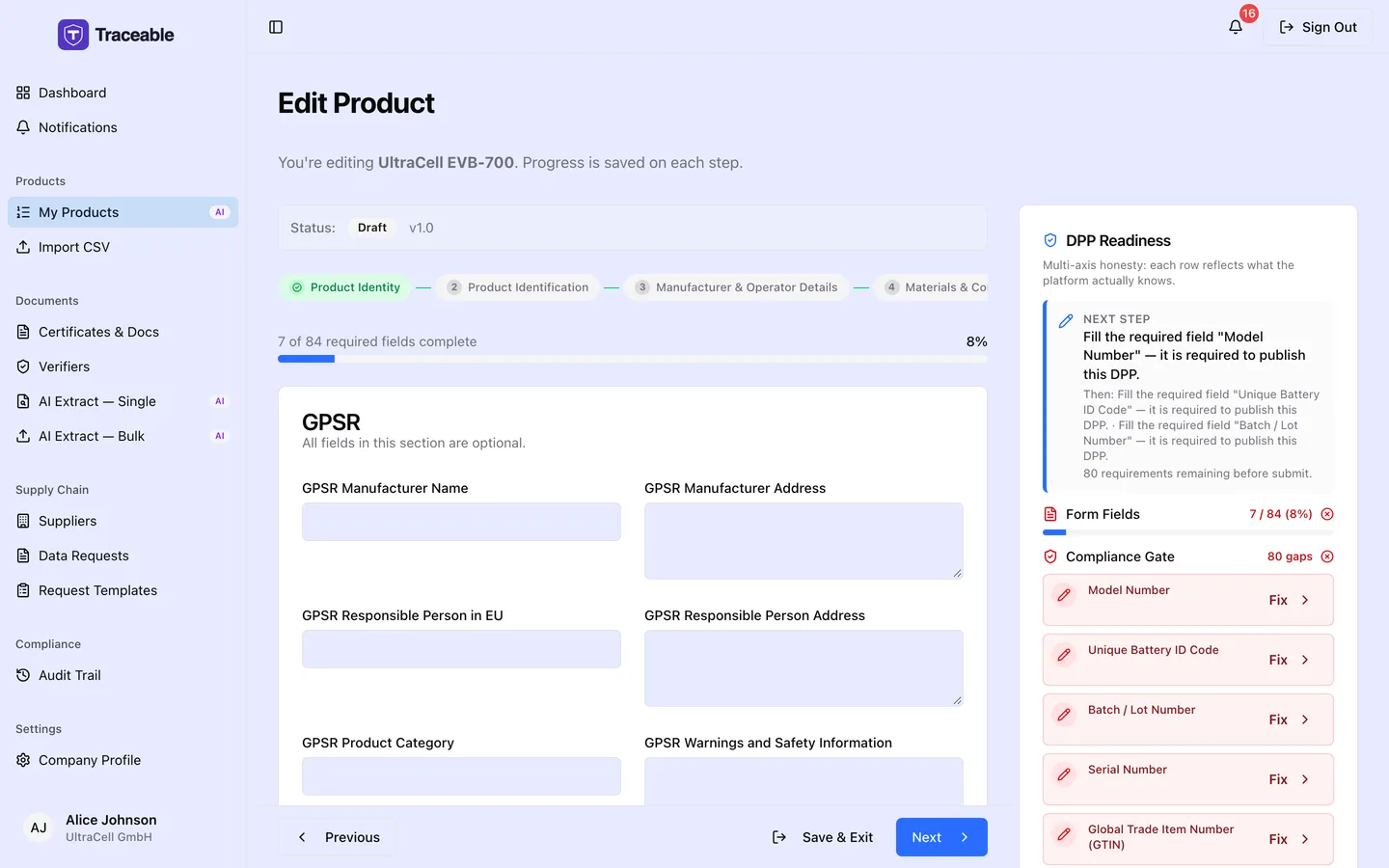
Step 11 — GPSR
The General Product Safety Regulation fields, held separately from the safety and certificate step above.
Step 12 — Review & Submit
The final step reports, in one place, exactly what still stands between this draft and a published passport: the count of required form fields completed, and every compliance-gate gap with a Fix link that jumps straight to the field responsible.
The example below is a freshly created draft, which is why it reads 7 of 84 required fields complete and 80 EU Battery Reg gaps must be fixed before publish. Those are the regulator-facing requirements, not a completeness score.
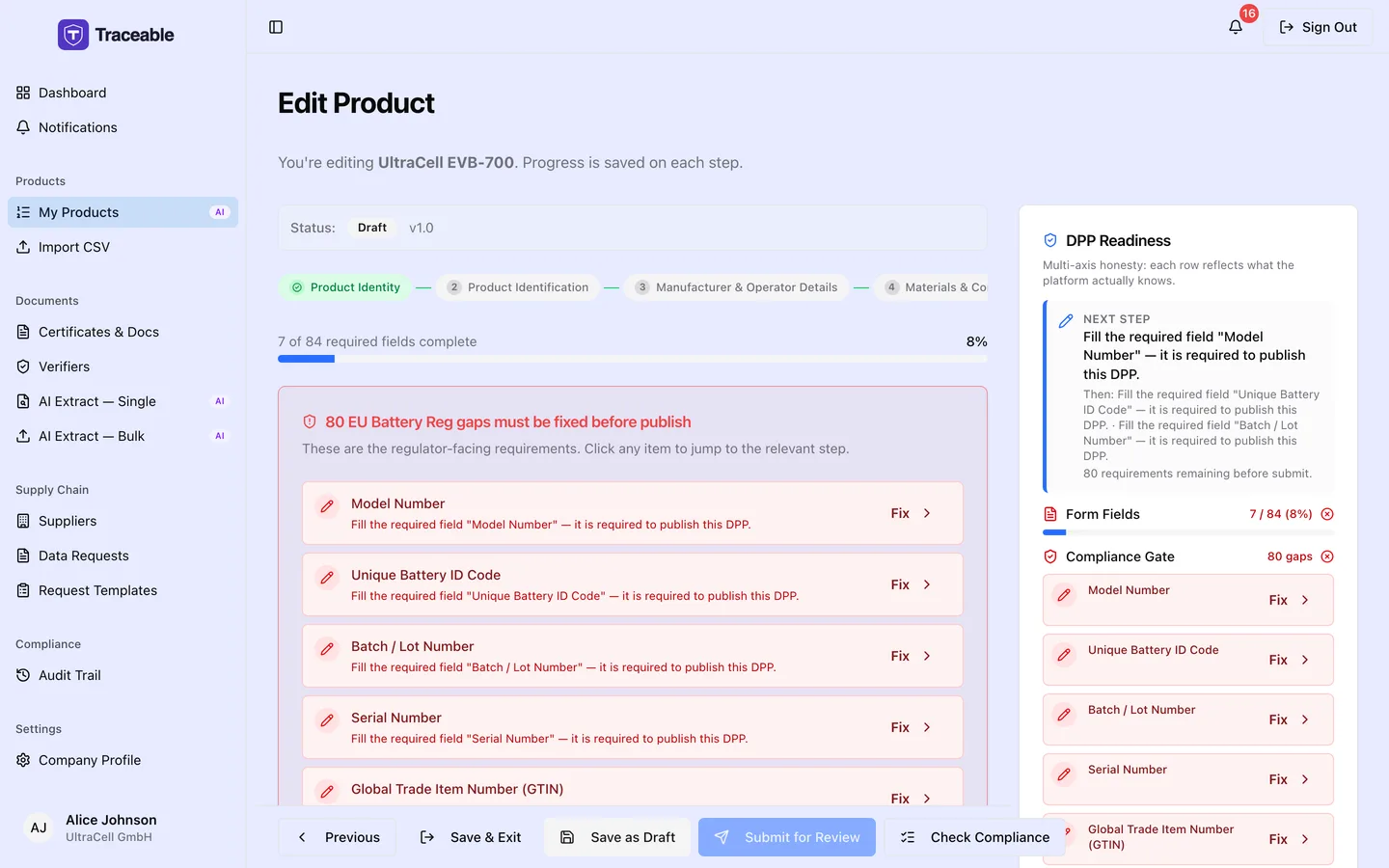
From here, Submit for Review moves the draft into review. Publication itself is a separate, deliberate action — see Publish a DPP.